Diesel Engine Crankshaft: The Complete Guide to Design, Materials, Failure and Replacement
Key points
- The diesel engine crankshaft converts combustion pressure into rotary motion and carries the highest structural loads in the engine.
- Diesel crankshafts are built around high peak cylinder pressure and torsional vibration — not high rpm. That is why they are forged, stiffer and surface-hardened.
- Fatigue life is decided by fillet condition, surface finish and damper health far more than by material grade alone.
- Most failures trace back to lubrication, torsional dampers, bearings or rebuild machining errors.
- Inspection means magnetic particle inspection plus dimensional measurement, always against OEM limits.
- Replacement requires exact engine identification, crankshaft variant, journal size and interface details.
Introduction
The diesel engine crankshaft is the single most heavily loaded component in a compression-ignition engine. It takes the linear, explosive force of combustion from every piston and converts it into usable rotary motion — while simultaneously absorbing bending loads, torsional vibration and the inertia of the entire rotating assembly.
Because a diesel fires at compression ratios of roughly 14:1 to 23:1 and peak cylinder pressures that can exceed 200 bar, its crankshaft is built very differently from a gasoline engine crankshaft. It is bigger, heavier, made from a stronger alloy, and finished with surface treatments a petrol crankshaft rarely needs.
This guide covers everything an engineer, fleet mechanic, rebuilder or parts buyer needs to know: what the crankshaft does, how diesel designs differ, which materials and manufacturing processes are used, how crankshafts fail, how to inspect and measure them, and how to specify a replacement correctly.
If you need to look up a part by brand and engine model, see the Komotashi crankshaft catalogue.
1. What Is a Diesel Engine Crankshaft?
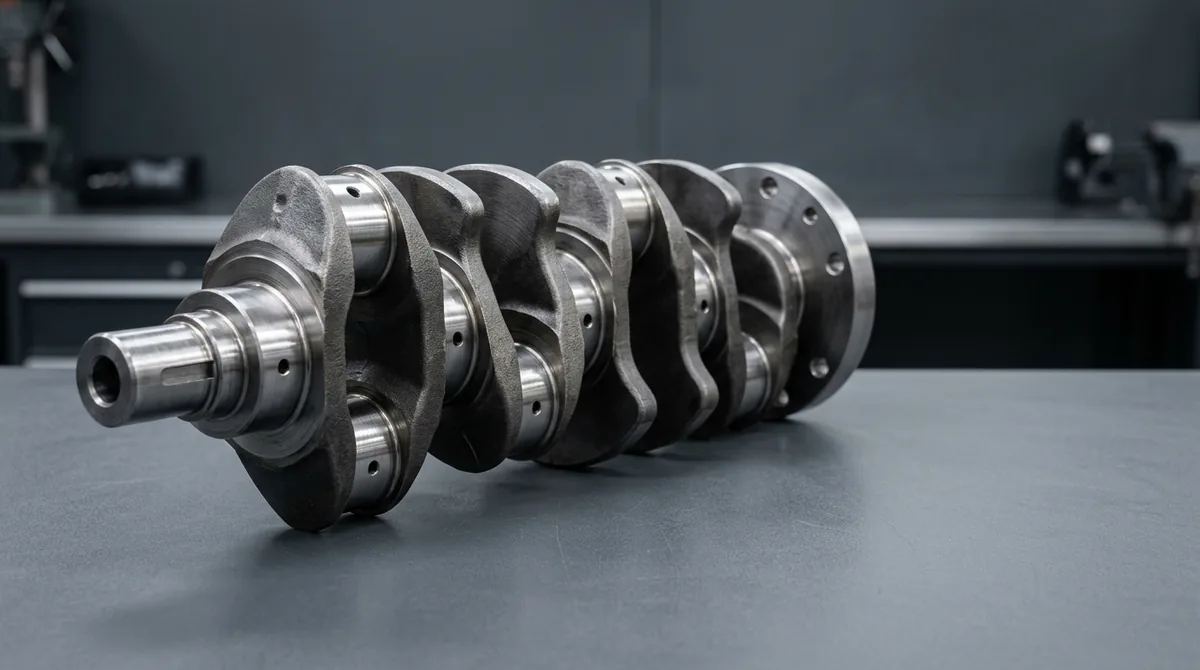
A diesel engine crankshaft is a rotating shaft with one or more offset journals — called crankpins — that connect to the engine's connecting rods. Each piston pushes down on its connecting rod, the rod pushes on a crankpin, and because the crankpin is offset from the crankshaft centreline, that linear force produces torque about the main axis.
In other words, the crankshaft is a mechanical translator: reciprocating motion in, rotary motion out.
It also drives everything bolted to it:
- The flywheel or flexplate, which smooths out pulsing power delivery and transmits torque to the transmission.
- The front pulley and damper, which drive the accessory belt and control torsional vibration.
- The timing drive (gear, chain or belt) that synchronises the camshaft, injection pump and — on some designs — the balance shafts.
A diesel crankshaft lives inside the crankcase, is supported by main bearings, and is located axially by thrust bearings that control end-float.
2. Crankshaft Anatomy: Key Terms You Need to Know
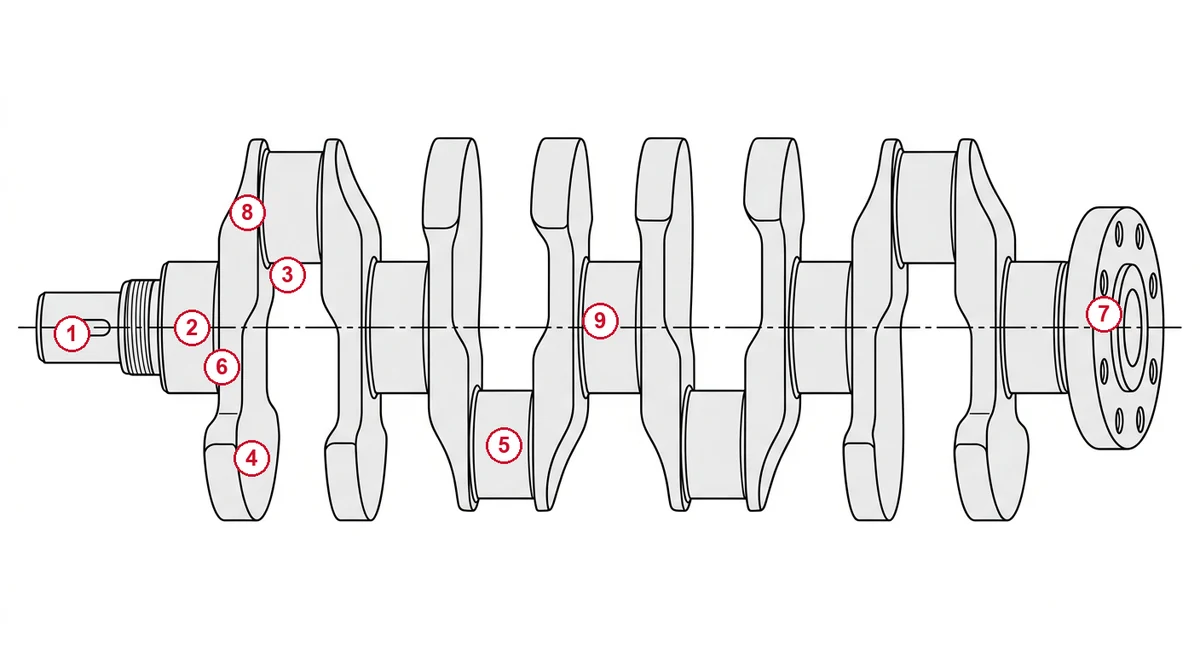
| Term | What it is | Why it matters |
|---|---|---|
| Main journal | The large-diameter sections that ride in the main bearings | Sets the crankshaft centreline; wear here causes low oil pressure and vibration |
| Crankpin (rod journal) | The offset journal the connecting rod bolts around | The highest-load bearing surface in the engine |
| Crank web | The material connecting a main journal to a crankpin | Where bending fatigue cracks usually start |
| Fillet | The radius where a journal meets a web | The single most critical feature for fatigue life |
| Counterweight | Mass opposite each crankpin | Balances rotating and reciprocating mass and reduces main bearing load |
| Throw / stroke | The offset distance; double it for the stroke | Determines displacement and engine character |
| Oil gallery | Cross-drilled passages feeding oil to the rod bearings | A blocked or mis-drilled gallery destroys the engine |
| Thrust face | The side surface that controls axial movement | Excessive end-float damages the block and transmission |
| Front nose / rear flange | Mounting points for pulley, damper and flywheel | Common site of keyway cracking and fretting |
| Damper seat | The journal the torsional vibration damper mounts on | Wrong damper means catastrophic torsional failure |
3. How the Crankshaft Works in a Diesel Cycle
In a four-stroke diesel, each cylinder fires once every two crankshaft revolutions. The crankshaft must therefore:
- Convert pressure into torque. At top dead centre, injected fuel ignites and cylinder pressure spikes. The connecting rod's angle relative to the crank throw determines how much of that force becomes torque.
- Store and release energy. The flywheel absorbs energy during the power stroke and returns it during intake, compression and exhaust — this is what keeps even a single-cylinder diesel running smoothly.
- Time the engine. Crankshaft position, read by a reluctor ring or tone wheel, tells the ECU when to inject and how much.
- Manage torsional vibration. Every power pulse twists the crankshaft slightly. Those twists reflect back and forth along its length. A torsional vibration damper at the front keeps the amplitudes from reaching destructive levels.
That last point is one of the most important differences between petrol and diesel crankshafts.
4. Diesel Crankshaft vs Gasoline Crankshaft: What Actually Changes
A diesel crankshaft is not just a beefed-up petrol crankshaft. The load case is fundamentally different.
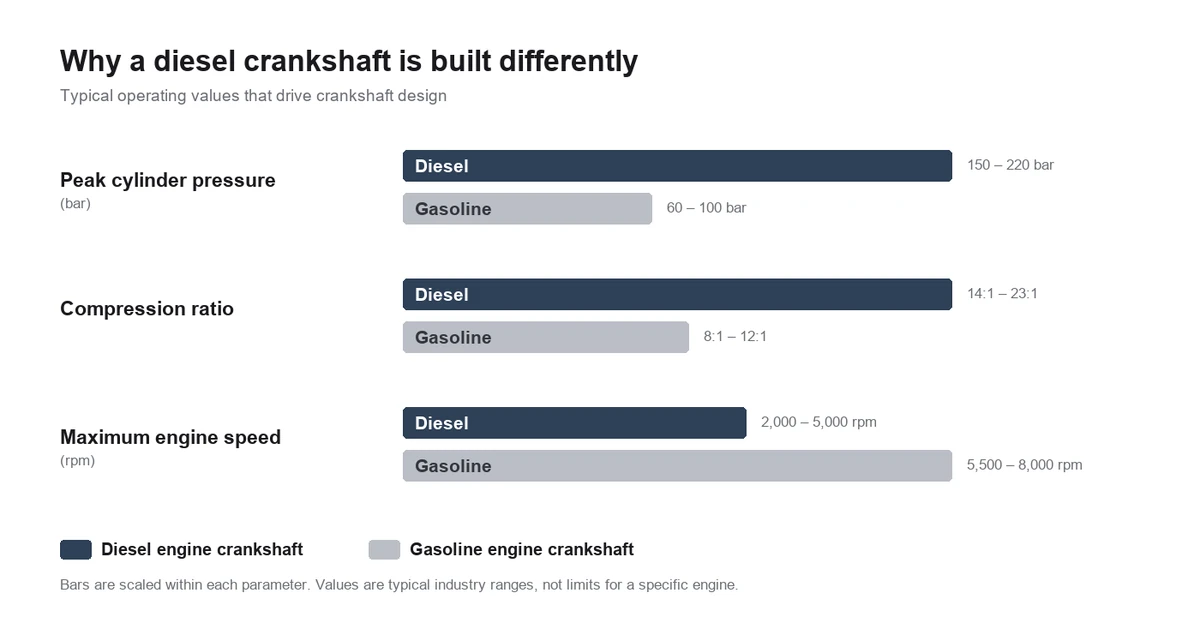
| Feature | Diesel engine crankshaft | Gasoline engine crankshaft |
|---|---|---|
| Compression ratio | 14:1 – 23:1 | 8:1 – 12:1 |
| Peak cylinder pressure | ~150 – 220+ bar | ~60 – 100 bar |
| Typical geometry | Longer stroke, larger throw | Shorter stroke, higher revs |
| Journal diameter | Larger for the same displacement | Smaller |
| Counterweighting | Heavier, often fully counterweighted | Frequently partially counterweighted |
| Typical material | Forged microalloyed or Cr-Mo steel; nodular iron in light-duty cast designs | Cast iron or forged steel |
| Surface treatment | Nitriding, induction hardening and fillet rolling are normal | Often as-machined or lightly hardened |
| Max engine speed | ~2,000 – 5,000 rpm | ~5,500 – 8,000 rpm |
| Failure driver | Bending fatigue + torsional vibration + high BMEP | High-cycle fatigue at high rpm |
The practical consequences:
- Diesel crankshafts are stiffness-driven. Long strokes and high cylinder pressure mean deflection must be limited, so journals are larger and webs thicker.
- Torsional vibration is the diesel's real enemy. A diesel's power pulses are sharper and its operating range sits closer to the natural frequencies of the crank train. Damper condition is not optional maintenance.
- Fatigue is bending-dominated, not rpm-dominated. Most diesel crankshaft failures start at a fillet under bending, not from overspeeding.
Cummins heavy-duty engines are a good example of this design philosophy: the Cummins K19 forged steel crankshaft is a one-piece forging in SAE 4140 / 42CrMo, specified for high hardness and fatigue resistance over a long overhaul interval.
5. Types and Configurations of Diesel Crankshafts
By engine layout
- Inline crankshafts (I3, I4, I6): the simplest geometry, one crankpin per cylinder, usually with 180° or 120° phase offsets. The inline-six is inherently balanced for primary and secondary forces, which is why it dominates heavy truck and industrial diesel applications.
- V-type crankshafts (V6, V8, V12): a single crankpin usually serves two opposing cylinders.
- Flat / opposed crankshafts: one crankpin per cylinder with 180° offsets; used in some industrial and marine diesels.
- One-piece vs built-up: small and medium diesels use one-piece crankshafts. Very large two-stroke marine diesels use built-up crankshafts, where webs, journals and pins are shrink-fitted together, because a single forging of that size is impractical.
By manufacturing route
- Forged crankshaft — the industry default for medium- and heavy-duty diesel, for example the Mercedes-Benz OM926 crankshaft.
- Cast crankshaft — nodular or ductile iron; common in light-duty and cost-sensitive applications, such as the Mercedes-Benz OM422 cast crankshaft.
- Billet crankshaft — CNC-machined from a solid bar; used in racing and low-volume performance builds.
By counterweighting
- Fully counterweighted — a counterweight opposite every crankpin. Lower main bearing loads, better balance. Standard on heavy-duty diesels.
- Partially counterweighted — reduces weight and inertia at the cost of higher main bearing loading.
6. Materials: What Diesel Crankshafts Are Made Of
| Material | Typical designation | Where it's used | Notes |
|---|---|---|---|
| Microalloyed forging steel | 38MnVS6, 46MnVS5 | High-volume light and medium diesel | Forged and air-cooled; no separate quench-and-temper needed, so lower cost |
| Medium-carbon steel | AISI 1045 / C45 / EN8 | Light-duty and rebuilt engines | Cheap; adequate at modest BMEP |
| Chromoly steel | AISI 4140 / 42CrMo4 / EN19 | Medium and heavy-duty diesel | The workhorse alloy: good hardenability, toughness and fatigue strength |
| Nickel-chromoly steel | AISI 4340 / EN24 / 40NiCrMo | High-output, marine and racing diesel | Highest strength and toughness; most expensive |
| Nodular (ductile) cast iron | GGG-60, GGG-70, ASTM A536 80-55-06 | Light-duty cast crankshafts | Good damping, lower cost, lower strength |
| Special marine steels | EA1N / EA4T / S34MnV | Large two-stroke diesel | Selected for toughness in very large sections |
Rules of thumb:
- If the engine is turbocharged, high-BMEP or in continuous duty, it almost certainly has a forged alloy crankshaft.
- Nitriding-grade steels containing Al, Cr, Mo and V respond well to gas or plasma nitriding, reaching surface hardness around 600–750 HV while leaving a tough core.
- Induction-hardened journals typically reach 45–58 HRC to a controlled depth, with the core at roughly 25–35 HRC.
At product level, the Mercedes-Benz OM471 forged steel crankshaft follows the complete route: forged alloy steel, hardened journals and rolled fillets.
7. How Diesel Crankshafts Are Manufactured
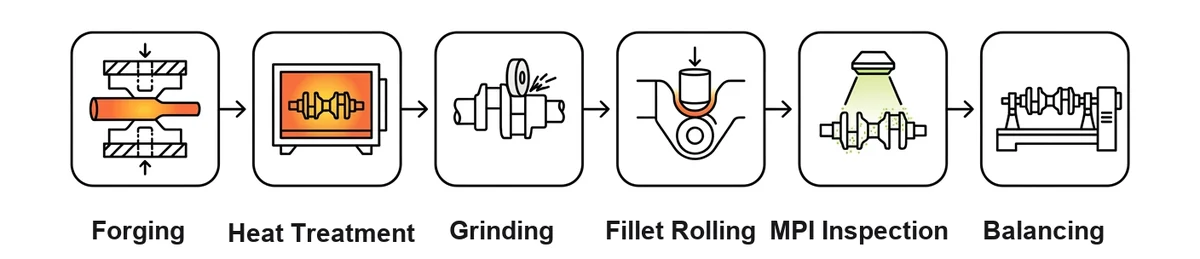
The process determines fatigue life, dimensional accuracy and price.
7.1 Forging
A billet heated to roughly 1,150–1,250 °C is shaped by:
- Die forging — the mainstream method. A press or hammer forms the crank in a closed die, then trimming removes flash.
- Roll forging or cross-wedge rolling — used to pre-form the throws efficiently.
- Twist forging — the crank is forged flat, then the throws are twisted into the correct phase angle. Efficient for multi-throw crankshafts.
Forging produces a continuous grain flow that follows the crank's shape. That grain flow is the main reason forged crankshafts outlast cast ones under bending fatigue — cracks must cross the grain rather than run along it.
7.2 Casting
Molten nodular iron is poured into a sand mould. Casting gives near-net shape, low machining cost and excellent vibration damping. Its weaknesses are porosity and lower tensile strength.
7.3 Heat treatment
- Normalising to refine grain structure
- Quench and temper for through-hardening
- Induction hardening of journals and fillets
- Nitriding (gas, salt-bath or plasma) for a hard, wear-resistant case
7.4 Machining
Journals are turned and then ground and polished to sub-micron finishes — typically Ra 0.2–0.4 µm. Oil holes are drilled with generous radii at the exits to avoid stress concentration, and their edges are chamfered and polished.
7.5 Fillet rolling (deep rolling)
This is the most under-appreciated step. A hardened roller is pressed into the fillet under controlled force, plastically deforming the surface and leaving a compressive residual stress layer.
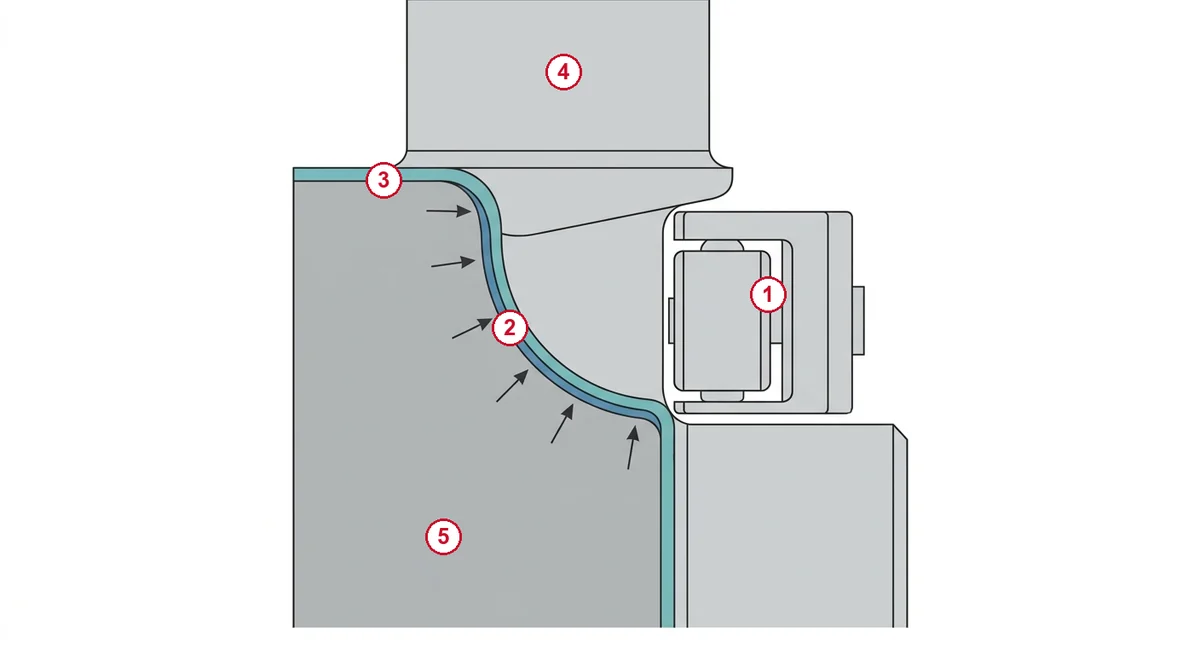
That compressive layer can increase bending fatigue strength by 30–100%. Many manufacturers roll the fillets both before and after grinding.
7.6 Surface treatment and finishing
- Nitriding for wear and fatigue resistance
- Shot peening to add further compressive stress
- Dynamic balancing to a specified unbalance tolerance
- Magnetic particle inspection (MPI) for crack detection on critical parts
- Nitrocarburising for a thin, hard compound layer on some journals
7.7 Quality control
Every production crankshaft should be checked for:
- Journal diameter, taper and ovality
- Fillet radius and surface finish
- Runout between main journals and at the flanges
- Hardness and case depth
- Cracks at fillets and oil holes
- Straightness and balance
8. Design and Specification Details That Matter
| Parameter | Typical diesel range | Effect |
|---|---|---|
| Main journal diameter | 60 – 130 mm (light to heavy duty) | Bearing load capacity and stiffness |
| Crankpin diameter | 50 – 120 mm | Rod bearing load capacity |
| Fillet radius | 2 – 6 mm, rolled | Governs fatigue life — never reduce it when regrinding |
| Journal surface finish | Ra 0.2 – 0.4 µm | Oil film formation and bearing life |
| Journal hardness (induction hardened) | 45 – 58 HRC | Wear resistance |
| Case depth (nitrided) | 0.2 – 0.6 mm | Fatigue and wear resistance |
| Max runout (OEM dependent) | ~0.02 – 0.05 mm | Vibration, bearing loading, seal life |
| End-float (thrust) | ~0.05 – 0.30 mm | Transmission and block damage if excessive |
| Balance tolerance | Application specific | NVH and bearing life |
Always confirm against the OEM service manual for the specific engine. These are indicative ranges, not universal limits.
9. Why Diesel Engine Crankshafts Fail
Crankshafts rarely fail because they are "weak". They fail because a load path changed.
| Failure mode | Typical appearance | Common root causes |
|---|---|---|
| Bending fatigue crack at the fillet | Crack radiating from a web fillet, often at 45° to the axis | Overload or tuning, wrong damper, excessive bearing clearance, block or main bore misalignment, damaged fillet radius |
| Torsional fatigue crack | Crack at 45° crossing a journal or web, often near the front or rear | Failed torsional damper, wrong firing order or phase, heavy accessory inertia, overspeed |
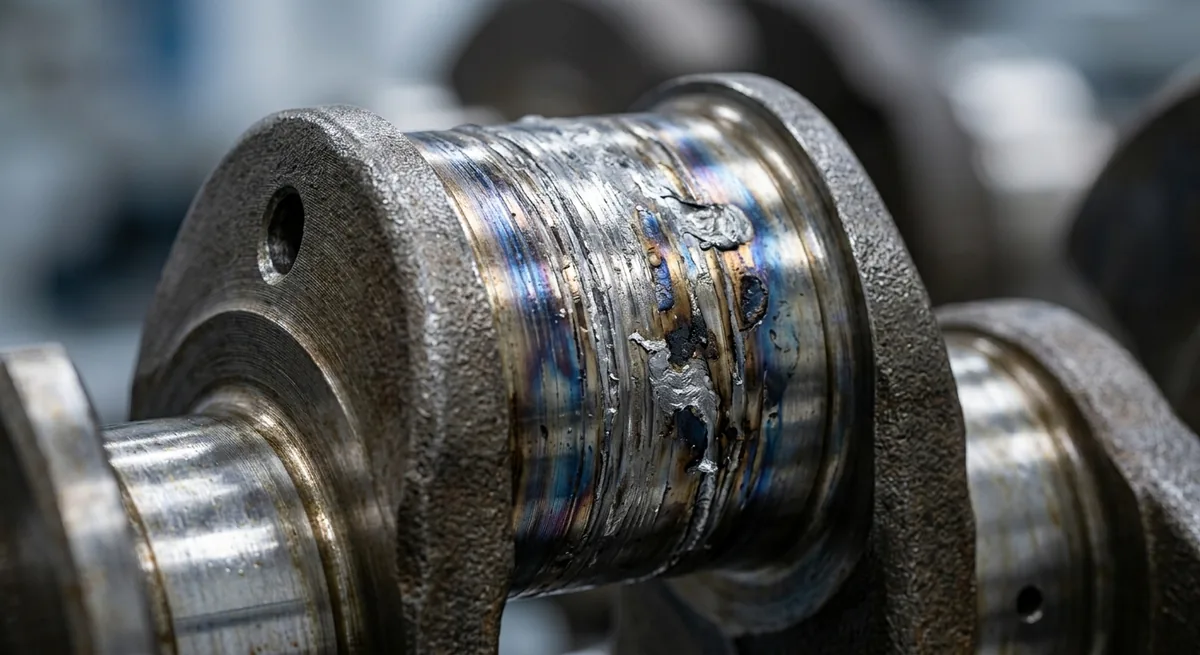
| Journal scoring and seizure | Deep circumferential grooves, blue discolouration, smeared bearing material | Oil starvation, wrong oil viscosity, contaminated oil, excessive bearing clearance |
| Excessive wear and out-of-round journals | Ovality, taper, low oil pressure when hot | Dirty oil, long oil intervals, abrasive particles, overloading |
| Thrust face wear | Worn or heat-damaged thrust surfaces, high end-float | Torque converter ballooning, clutch riding, mis-set thrust clearance |
| Crack at the oil hole | Radial crack originating at the gallery exit | Sharp oil-hole edge, inadequate radius or polishing |
| Keyway and nose cracking | Crack from the keyway corner | Loose damper or pulley, fretting, over- or under-torqued bolt |
| Flange cracking | Cracks around the flywheel bolt holes | Loose flywheel bolts, misalignment, damaged dowels |
| Bending and bowing | Runout out of spec after a bearing failure | Hydrolock, overheat, spun main bearing |
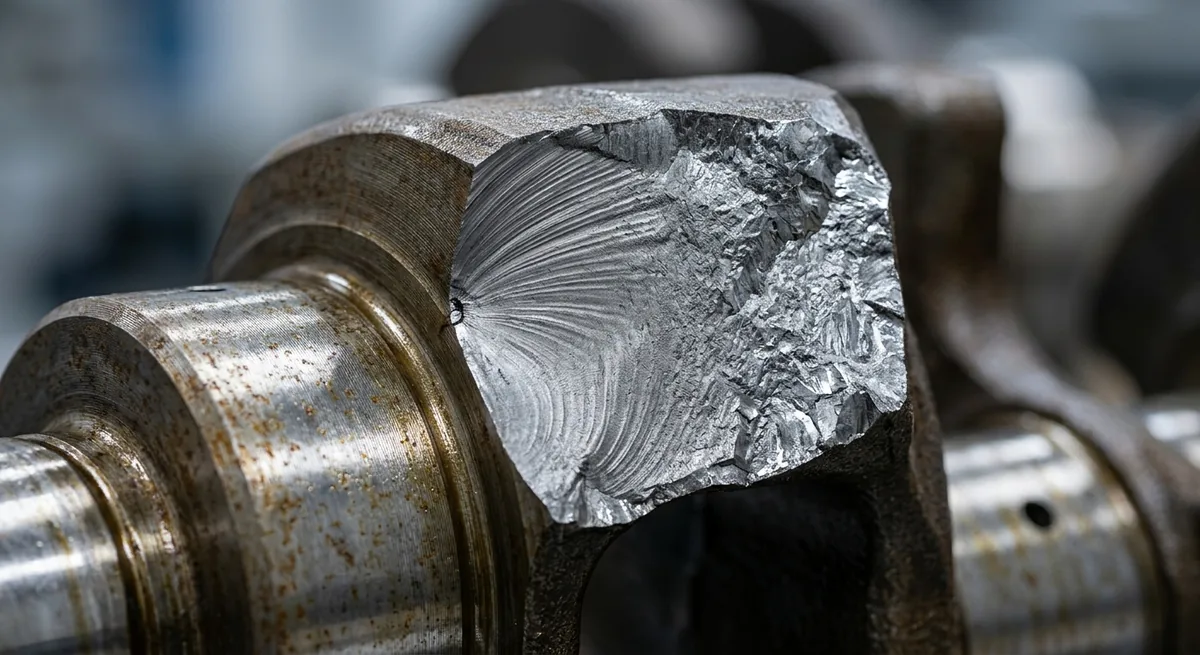
The three most common real-world triggers, in practice:
- Damper failure. A worn or incorrect torsional vibration damper is the number one cause of unexplained diesel crankshaft breakage on high-mileage engines.
- Lubrication failure. Oil starvation destroys journal surfaces faster than any fatigue mechanism. Heavy-duty long-stroke engines such as the Cummins NT855 crankshaft are particularly sensitive because they run at high continuous load.
- Machining mistakes at rebuild. An under-radiused fillet, or a crank ground below the OEM minimum undersize limit, turns a good crankshaft into a time bomb.
10. Symptoms of a Failing Diesel Crankshaft
| Symptom | What it usually indicates |
|---|---|
| Deep, rhythmic knocking from the crankcase, loudest under load | Worn main or rod bearings, excessive clearance |
| Low oil pressure at idle when hot | Worn main journals or bearings |
| Metallic debris or bearing material in the oil | Bearing failure in progress |
| Vibration that changes with engine speed | Balance loss, runout or damper failure |
| Hard starting or erratic timing codes | Damaged reluctor ring, tone wheel or shifted crank position |
| Oil leaks at the front or rear seal | Runout at the seal journal |
| Clutch or transmission problems, odd driveline noise | Excessive crankshaft end-float |
| Sudden catastrophic failure with no warning | A fatigue crack that finally propagated — usually preceded by a damper or bearing issue |
Any of these warrants a proper measurement-based inspection, not a guess.
11. How to Inspect and Measure a Diesel Crankshaft
Whether you are rebuilding an engine or qualifying an incoming part, follow a fixed sequence.
Crack and visual inspection
- Clean it thoroughly. Solvent wash, then dry. Contamination hides cracks.
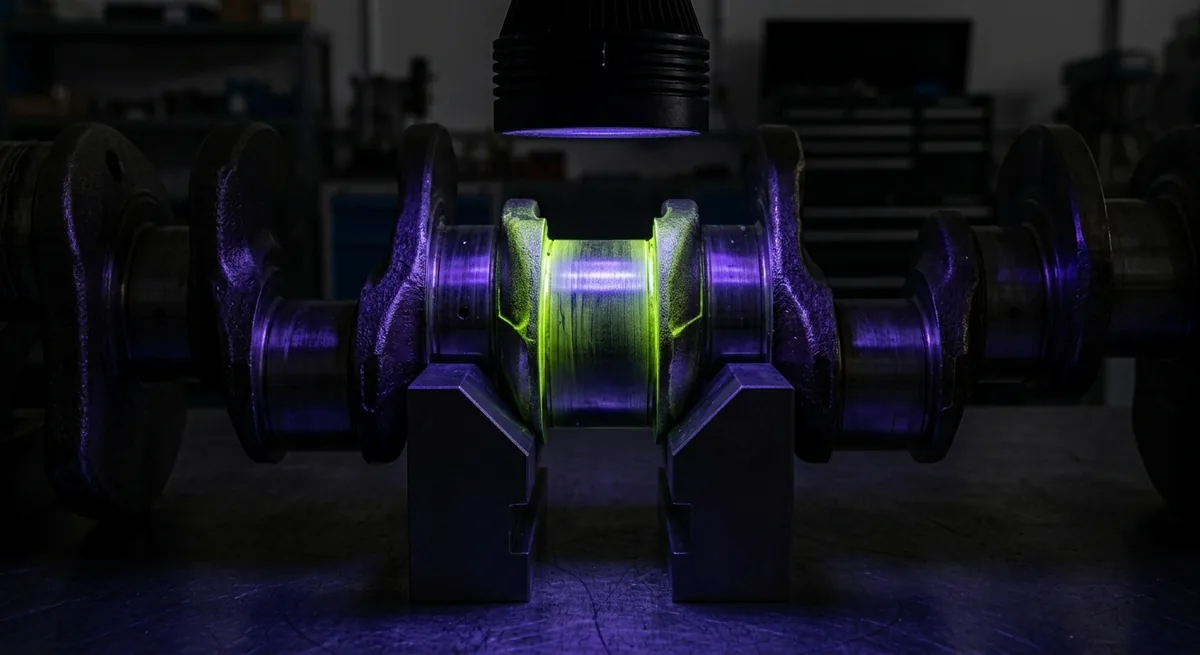
- Magnetic particle inspection (MPI) on the fillets, oil holes, keyways and flanges. This is the only reliable way to find early fatigue cracks.
- Dye penetrant as a fallback where MPI isn't available.
- Look for heat damage — blue or black discolouration indicates a spun bearing and usually condemns the crank.
Dimensional measurement
| Check | Method | Acceptance |
|---|---|---|
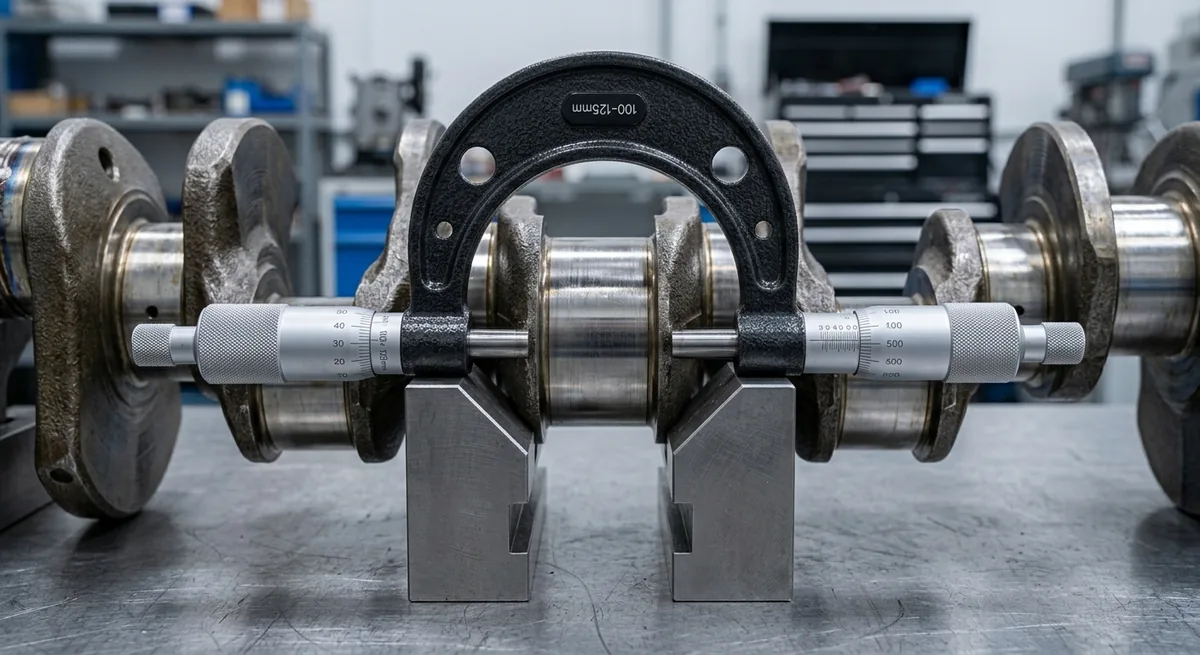
| Journal diameter | Micrometer, measured at two positions and two axes | Within OEM min/max |
| Ovality | Max minus min diameter at one position | Typically ≤ 0.01–0.02 mm |
| Taper | Diameter difference across the journal length | Typically ≤ 0.01–0.02 mm |
| Runout | Dial indicator, crank supported on V-blocks or in the block | Compare to the OEM limit |
| Fillet radius | Radius gauges or optical comparison | Must not be smaller than specification |
| Thrust clearance / end-float | Feeler gauge or dial indicator | Per OEM |
| Hardness | Portable or bench hardness tester | Compare to specification |
| Straightness | V-block and indicator along the axis | Per OEM |
| Surface finish | Comparator or profilometer | Ra 0.2–0.4 µm target |
Related parts: a crankshaft is not a standalone component. It forms a load path with the cylinder block main bores, the cylinder head and the connecting rods. A deviation anywhere in that chain changes the loads the crankshaft sees.
Rebuild checks
- MPI after grinding, always.
- Re-balance after any material removal.
- Verify journal-to-fillet blending — the grinding wheel must leave a smooth, correctly radiused transition, not a sharp step.
12. Crankshaft Regrinding and Undersize Bearings
When journals are scored or out of round, a crankshaft may be reground — provided enough material remains.
- Grinding is normally done in 0.25 mm (0.010") increments, sometimes 0.50 mm (0.020") and on some engines 0.75 mm (0.030") or 1.00 mm (0.040").
- Matching undersize bearing shells (`STD`, `.010`, `.020`, `.030`) are fitted to the new journal diameter.
- Heavy-metal or weld repair is a specialist option for rare or obsolete crankshafts and is generally not recommended for high-load diesel service.
- Never grind past the OEM minimum diameter — both the hardening case depth and the shaft's bending stiffness fall away quickly.
Critical rule: regrinding changes the fillet. If the operator does not restore the correct radius and surface finish, fatigue life drops sharply even though the journals measure "in spec".
13. Choosing and Ordering a Replacement Diesel Engine Crankshaft
If the crankshaft is cracked, bent or worn below minimum, replacement is the safe path. To order correctly you need:
- Engine make, model and full serial number — the same engine family often uses several crank variants.
- OEM part number, plus any superseded numbers.
- Crankshaft type — forged or cast, fully or partially counterweighted, with or without a damper seat, reluctor ring or specific flange pattern.
- Journal dimensions — STD or a specific undersize.
- Stroke and throw — verify against your engine's specification, especially on engines built in multiple ratings.
- Accessory interface — flywheel bolt pattern, damper keyway, front pulley and pilot bearing bore.
- Documentation — MPI report, material certificate, hardness and case-depth data, and a dimensional inspection report.
| Consideration | Forged | Cast (nodular iron) |
|---|---|---|
| Fatigue strength | High | Moderate |
| Cost | Higher | Lower |
| Damping | Lower | Higher |
| Best for | Heavy-duty, turbocharged, continuous duty | Light-duty, naturally aspirated, cost-sensitive |
| Repairability | Grind, then re-nitride or re-roll | Grind carefully; the case may be shallow |
For heavy-duty and turbocharged diesel applications, the specification to aim for is a forged crankshaft with nitrided or induction-hardened journals and rolled fillets.
Specific examples you can compare against include the Ford 9L crankshaft (OEM J1J6-6302-BA) and the Chongqing Cummins QSK19 crankshaft.
14. Installation and Maintenance Best Practices
Most crankshaft failures at rebuild are avoidable. Get these right:
- Torque and stretch are not optional. Main bearing caps and flywheel bolts must be torqued in the specified sequence, and torque-to-yield fasteners must be replaced.
- Check main bore alignment before installing the crank. A distorted block or a line-bore issue will bend a new crankshaft.
- Measure clearance, don't assume it. Plastigauge or micrometer-and-bore-gauge every main and rod journal.
- Replace the torsional damper on high-mileage rebuilds. It is a wear item with a rubber element that ages out.
- Prime the oil system before first start, and verify flow through every crank oil hole.
- Use the specified oil — viscosity and API CK-4 or OEM specification matter more on diesel than on petrol.
- Keep the crank clean. Grit inside an oil gallery destroys bearings within minutes.
- Re-balance the rotating assembly if any component (crank, damper, flywheel, rods, pistons) changed mass.
- Store crankshafts vertically or properly supported — a crankshaft laid on the ground for months can take a set.
15. Glossary
| Term | Meaning |
|---|---|
| BMEP | Brake mean effective pressure — how hard the engine works per unit displacement |
| Counterweight | Mass opposite a crankpin that balances the rotating assembly |
| Crankpin | The offset journal that carries the connecting rod |
| Damper | Torsional vibration damper fitted to the front of the crankshaft |
| End-float | Axial movement of the crankshaft, controlled by the thrust bearing |
| Fillet | The radius where a journal transitions into a web |
| Fillet rolling | Cold-working the fillet to induce compressive residual stress |
| MPI | Magnetic particle inspection — a crack detection method |
| Nitriding | Surface hardening by diffusing nitrogen into the steel |
| Runout | Deviation from true rotation, measured with a dial indicator |
| Throw | Distance from the main journal axis to the crankpin axis |
| Undersize | Bearing shells sized for a reground, smaller journal |
16. Key Takeaways
- The diesel engine crankshaft turns combustion pressure into rotary motion and carries the highest structural loads in the engine.
- Diesel crankshafts are designed around high cylinder pressure and torsional vibration, which is why they are forged, stiffer and surface-hardened.
- Fillet condition, surface finish and damper health drive fatigue life more than raw material grade.
- Most failures trace back to lubrication, dampers, bearings or rebuild machining errors — not to the crankshaft being under-designed.
- Inspection means MPI plus dimensional measurement, always against OEM limits.
- Replacement requires exact engine identification, crank variant, journal size and interface details, plus documentation.
Disclaimer: All figures in this guide are typical industry values, for orientation only. Always follow the OEM service manual for the specific engine being serviced.